

Getting Started Guide
Learn how to authenticate with Okta, navigate the Newline Dashboard, search transactions, review reports, and access support resources.
Use the Newline™ Dashboard to review transaction activity, account balances, and operational metrics across the Newline platform. Engineering, operations, and accounting teams can monitor activity, investigate transactions, and review program performance without direct API interaction. Key functionality is centralized on the Home screen, where users can view balances, track payout performance, analyze settlement trends, review customer activity, and access support resources. This guide outlines how to navigate the dashboard and use its core features to complete common tasks such as locating transactions, troubleshooting issues, and analyzing activity.
Authentication with Okta
All users must authenticate through Okta to access the Newline™ Dashboard. Okta provides token-based identity verification and helps limit dashboard access to configured users.
Steps to Authenticate
-
Invitation Email
After receiving an invitation email from your Newline representative, select the login link and follow the prompts to create your credentials. -
Set Up Multi-Factor Authentication (MFA)
Complete the Okta setup process using the Okta Verify app or another configured authentication method. -
Log In and Access the Dashboard
After authentication, you will be redirected to the Home screen, where you can begin reviewing data and navigating the platform.
Troubleshooting Access Issues
- If you did not receive an account invitation, contact your Fifth Third implementation representative.
- If you are unable to complete MFA, verify that your authentication method is properly configured in Okta.
- If you forget your credentials, use the Okta password recovery option on the login page.
- For persistent access issues, submit a request through the Service Desk.
Accessing the Dashboard
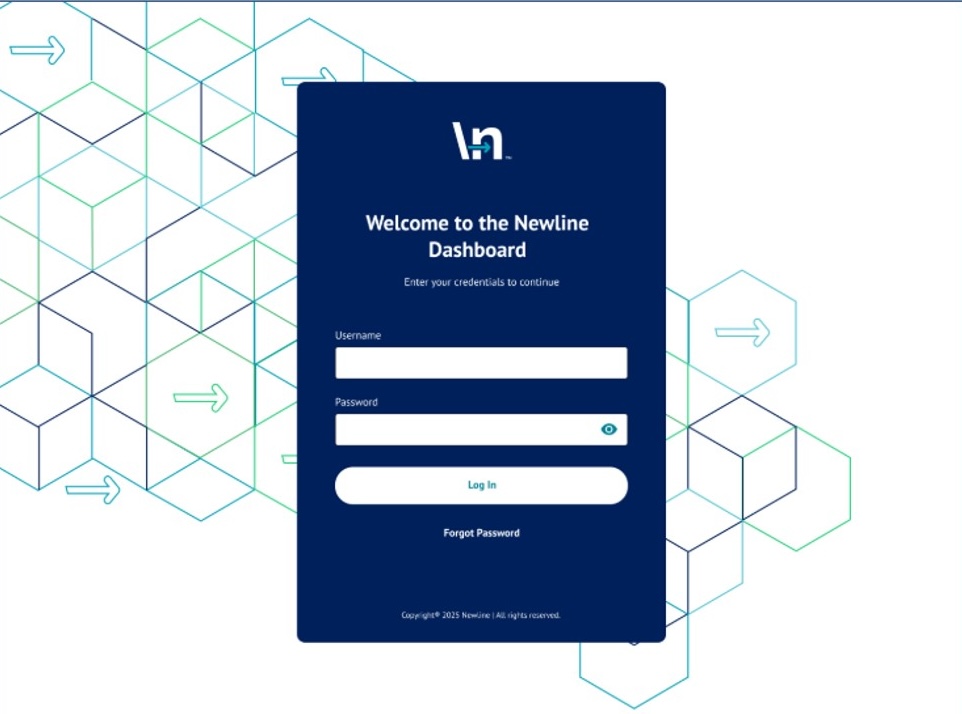
Log in to the Newline Dashboard using your Okta credentials. Upon successful authentication, you’ll be directed to the Home screen.
Getting Started in the Dashboard
After logging in, most users will:
- Review the Home screen for a high-level summary of activity and performance.
- Use the transaction search bar to locate a transaction by Transaction UID or other identifiers.
- Analyze program metrics and settlement trends directly within the Home screen.
- Review support resources as needed.
Home screen overview
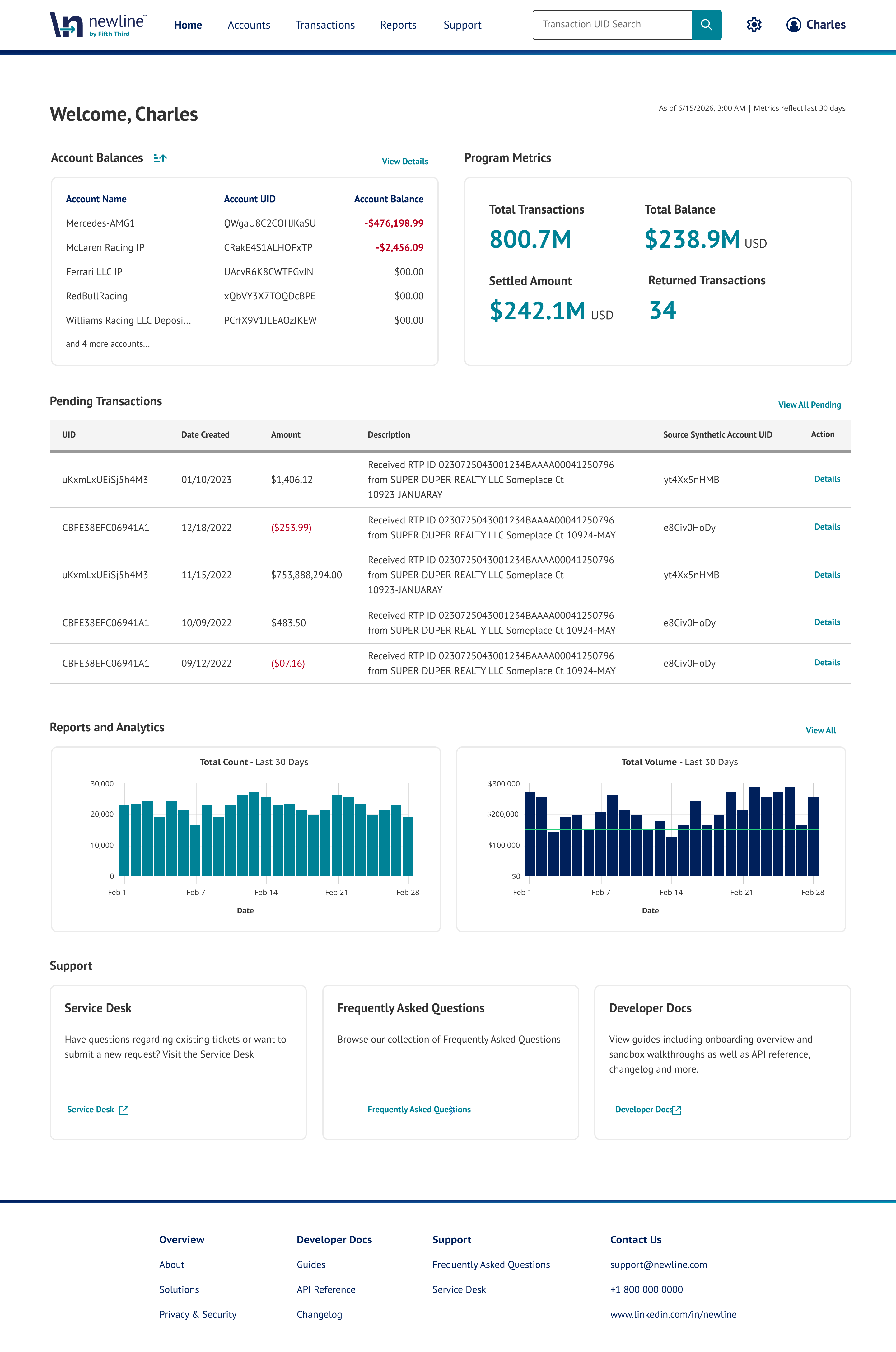
The Home screen summarizes your program’s operational performance, including key metrics, activity, and support resources.
Account Balances
Provides a summary of associated accounts, including:
- Account Name
- Account UID
- Account Balance
Program Metrics
Highlights key indicators of program activity, including:
- Total Transactions
- Available Balance
- Returned Amount
- Returned Transactions
Pending Transactions
Displays transactions that are currently in progress or awaiting completion, offering visibility into in-flight activity.
Reports and Analytics
Provides access to analytics and reporting tools directly from the Home screen, enabling users to review transaction trends and activity across payment types.
These visualizations support performance monitoring, trend analysis, and operational decision-making.
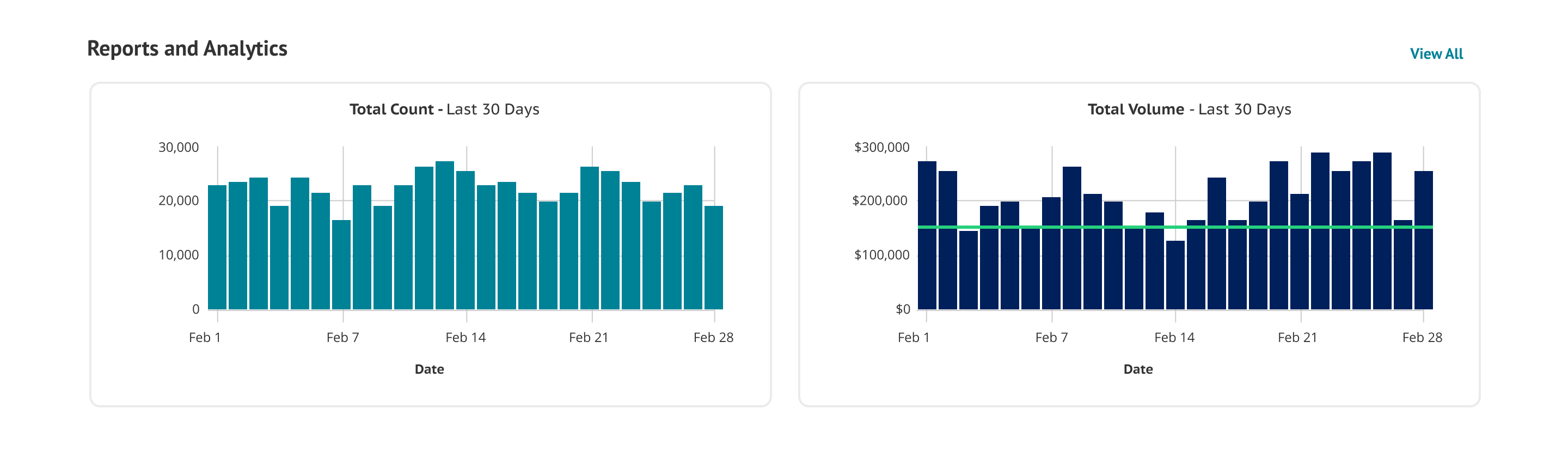
The Reports & Analytics section provides aggregated views of transaction activity, including:
- Transaction volumes
- Transaction counts
- Visual trends over time
These insights are useful for:
- Monitoring program performance
- Identifying trends in activity
- Supporting operational and financial review processes
Note:
For detailed reporting and reconciliation workflows, refer to CSV reporting (Intraday and Prior Day reports), which provide complete transactional datasets.
Support
Provides access to support resources, including:
- Service Desk
- Frequently Asked Questions (FAQs)
- Developer Documentation
Tabs
While the Home screen provides a high-level overview of account activity and performance, additional tabs offer more detailed views and functionality. The sections below outline how to navigate and use the Accounts, Transactions, Reports, and Support tabs to access more granular data and perform specific tasks.
Accounts
Use the Accounts tab to view account-level information for your assigned program, including:
- Account Name
- Account UID
- Account Balance
This view helps confirm available funds and identify the accounts associated with dashboard activity.
Transactions
Use the Transactions tab to review detailed transaction activity. From this view, you can:
- Investigate transaction status
- Review sender and receiver details
- Apply filters to refine results for operational or customer inquiries
Searching Transactions
Use the search bar in the header to quickly locate transactions by entering a Transaction UID or other supported identifiers.
Common Use Cases
- Investigate a failed transaction
- Locate a transaction for a customer inquiry
- Review transaction details
Search Options
You can search using the following identifiers:
- Transaction UID
- IMAD
- Network ID
- SEC Code
- Transfer ID
- UETR
- VRN (Virtual Reference Number)
Understanding Results
Search results include:
- Transaction status
- Sender and receiver details
- Transaction metadata
Transaction Status
- Pending – Transaction is in progress
- Settled – Transaction has completed successfully
- Failed / Returned – Transaction did not complete successfully
The transaction search bar is accessible from the header, allowing you to locate transactions from anywhere in the dashboard.
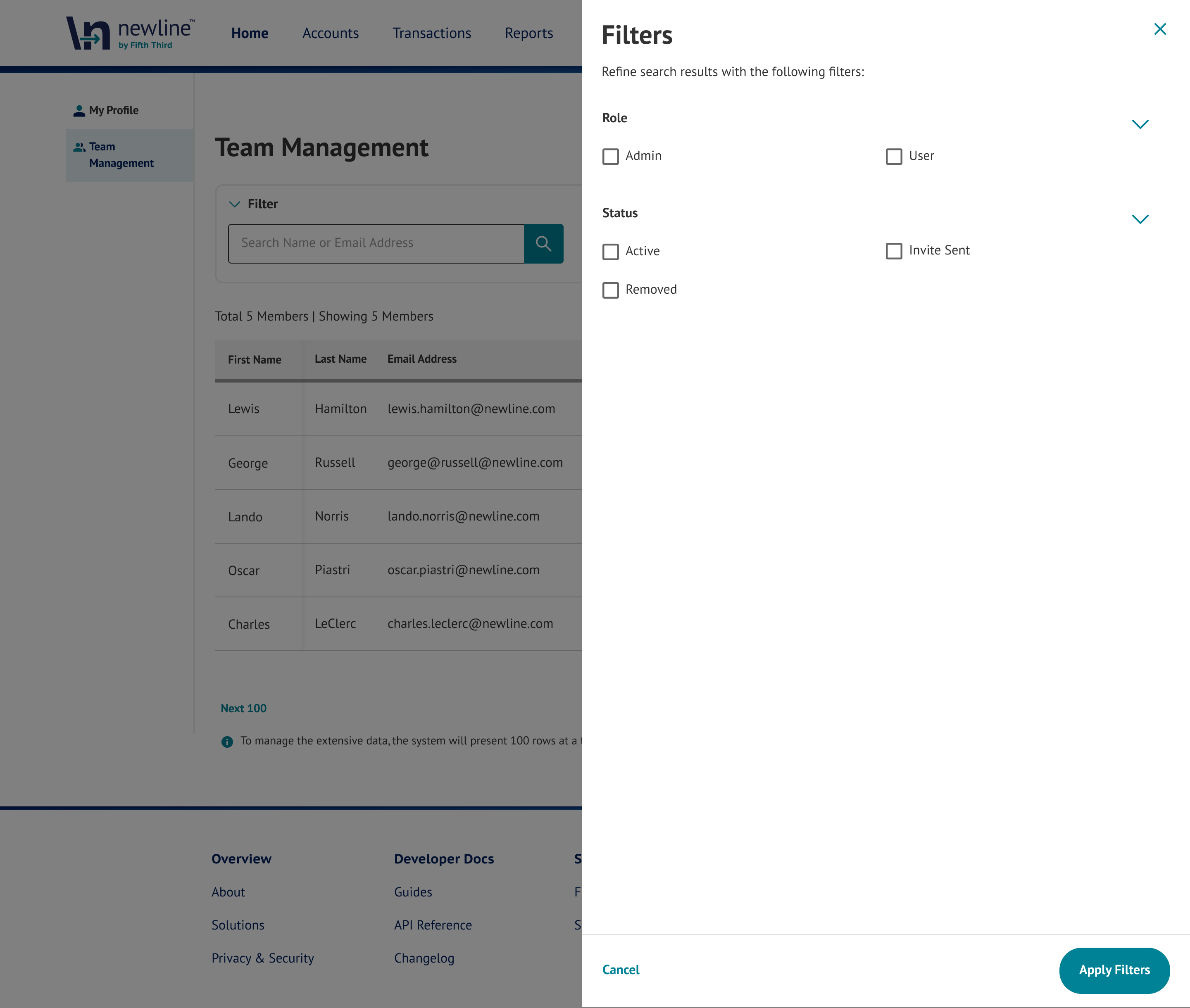
Filter
Filter options are available to refine search results.
Reports Tab
The Reports page provides detailed analytics on transaction activity and performance across different payment rails. Users can view high-level summaries or drill down into specific transaction types using tab-based navigation.
At the top of the Reports page, users can:
- Switch between report views using tabs:
- Overview
- Book Transfers
- Wires
- ACH
- RTP
- Filter data by program using the All Programs dropdown
- View data based on a rolling time window (for example, last 30 days)
Overview Tab
The Overview tab aggregates activity across all payment types and presents:
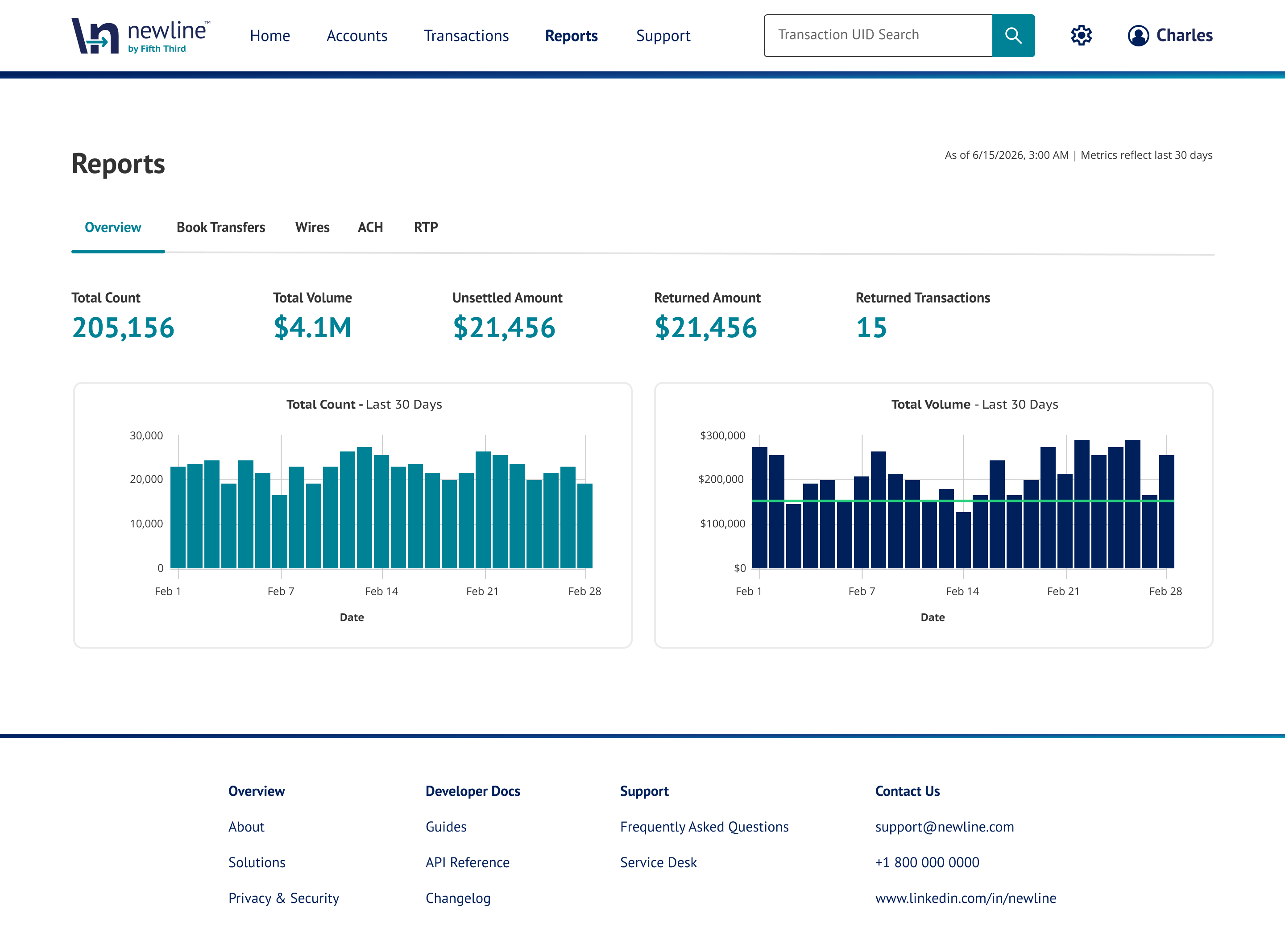
- Total Count – Total number of transactions
- Total Volume – Combined transaction value
- Unsettled Amount – Transactions that have not yet settled
- Returned Amount – Total value of returned funds
- Returned Transactions – Count of returned transactions
Visualizations include:
- Total Count over time
- Total Volume over time
Payment Rail Tabs
Each payment type (Book Transfers, Wires, ACH, RTP) has its own tab with focused metrics and charts.
Common Metrics
Depending on the selected tab, metrics may include:
- Total Count
- Total Volume
- Unsettled Amount
- Returned Amount (ACH only)
- Returned Transactions (ACH only)
Book Transfers Tab
Displays Book Transfer activity using summary metrics
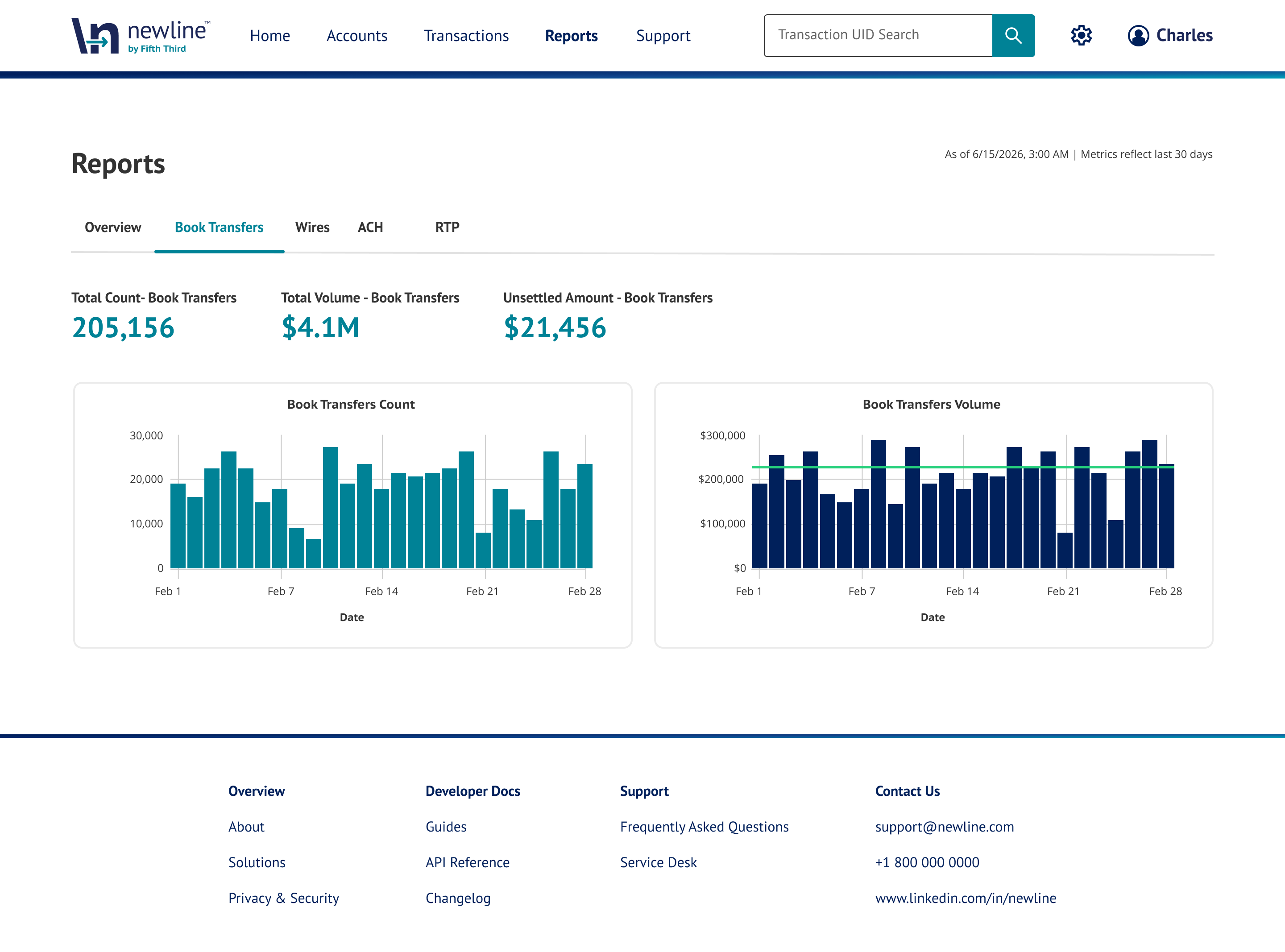
Summary Metrics
- Total Count – Book Transfers – Total number of Book Transfers transactions
- Total Volume – Book Transfers – Total value of Book Transfers transactions
- Unsettled Amount – Book Transfers – Total value of Book Transfers transactions that have not yet settled
Wires Tab
Displays Wire transaction activity using summary metrics
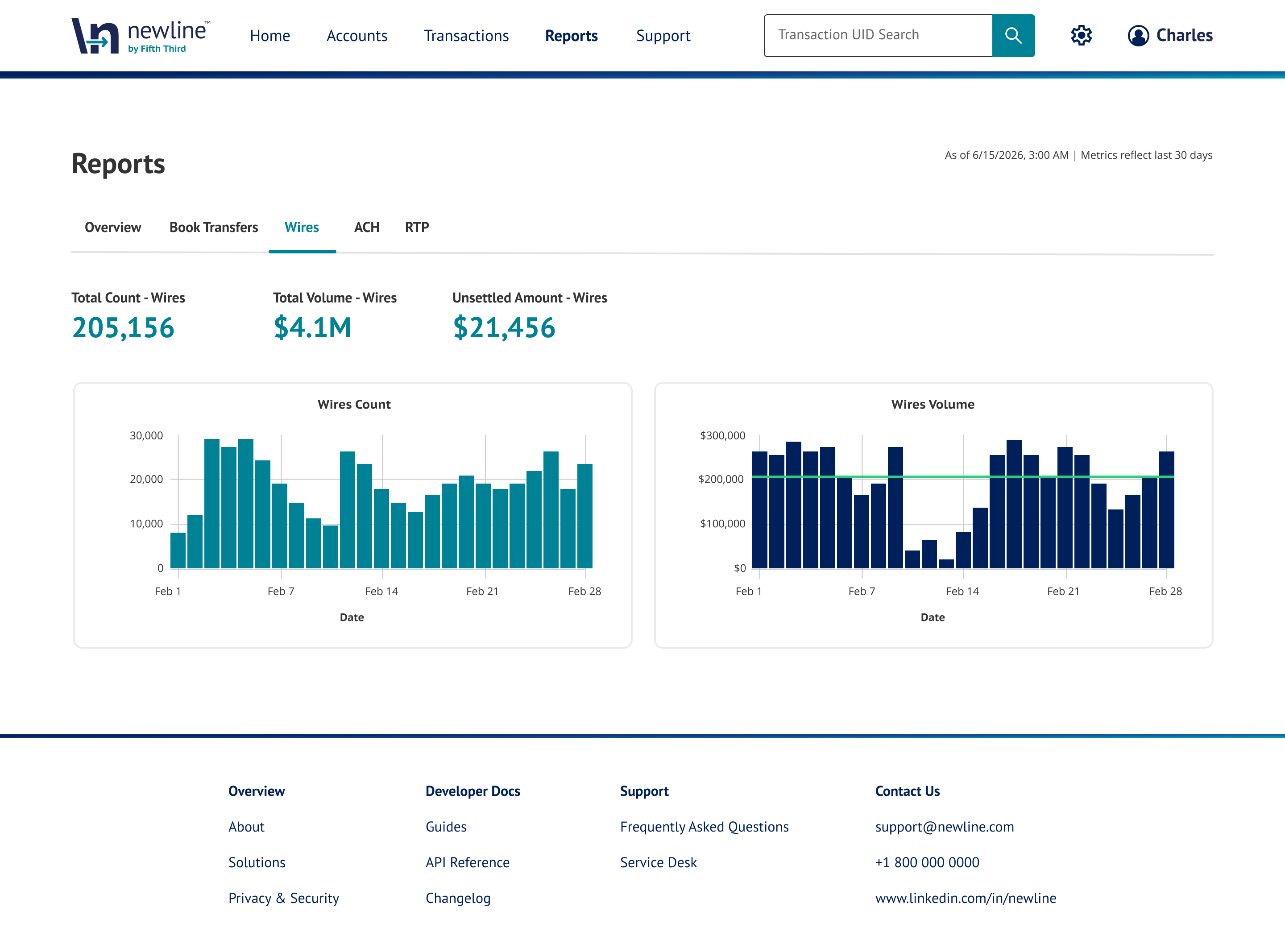
Summary Metrics
- Total Count – Wires – Total number of Wire transactions
- Total Volume – Wires – Total value of Wire transactions
- Unsettled Amount – Wires – Total value of Wire transactions that have not yet settled
Visualizations
- Wires Count – Displays Wire transaction count
- Wires Volume – Displays Wire transaction volume over time
ACH Tab
Displays ACH transaction activity using summary metrics and detailed reporting
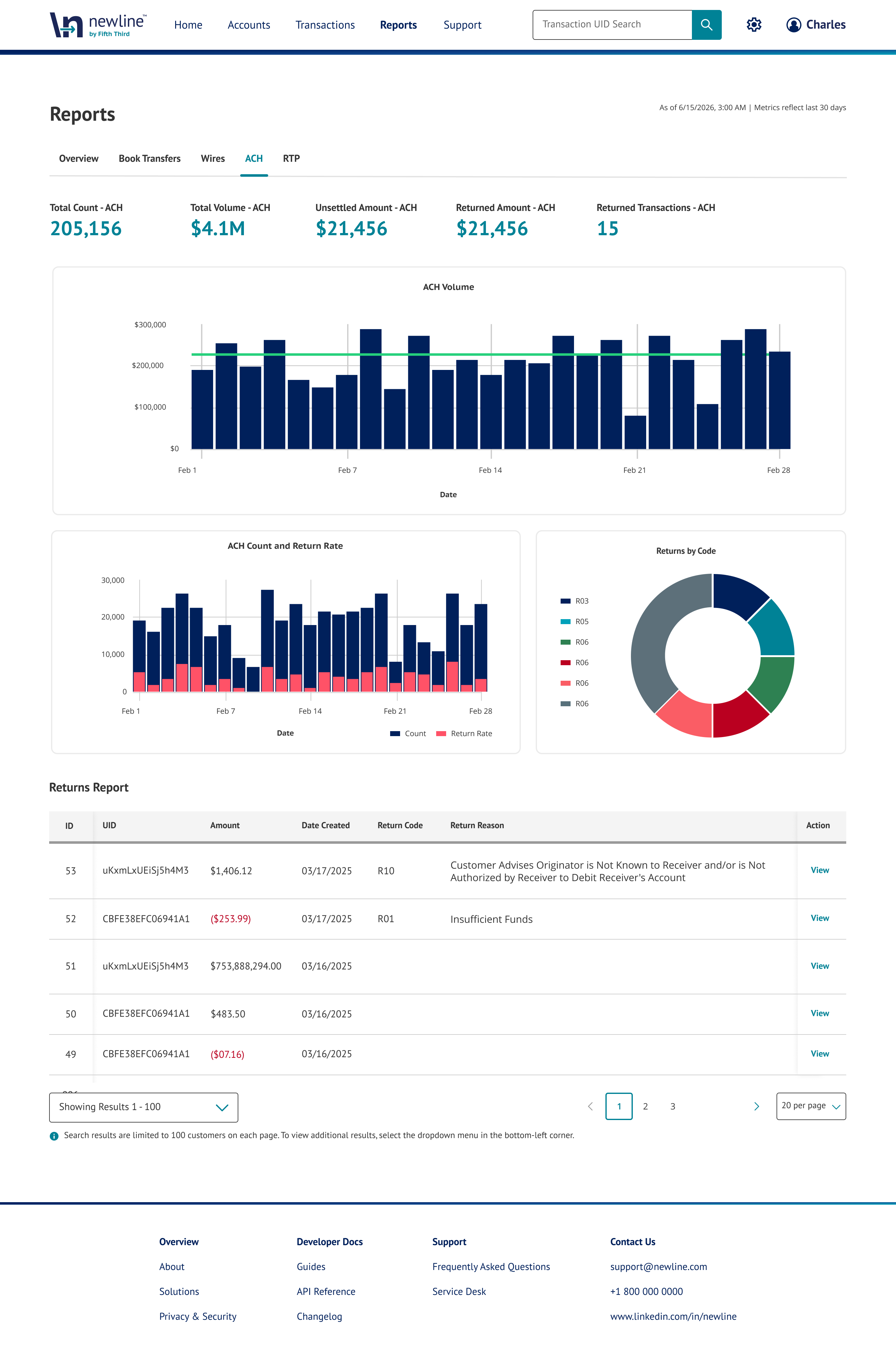
Summary Metrics
- Total Count – ACH – Total number of ACH transactions
- Total Volume – ACH – Total value of ACH transactions
- Unsettled Amount – ACH – Total value of ACH transactions that have not yet settled
- Returned Transactions – ACH – Total number of returned ACH transactions
Visualizations
- ACH Volume – Displays ACH transaction volume over time
- ACH Count and Return Rate – Displays transaction count alongside return rate trends
- Return by Code – Provides a breakdown of returns by return code
Returns Report
The Returns Report provides detailed information on returned ACH transactions, including:
- ID
- UID
- Amount
- Date Created
- Return Code
- Return Balance
- Action
RTP Tab
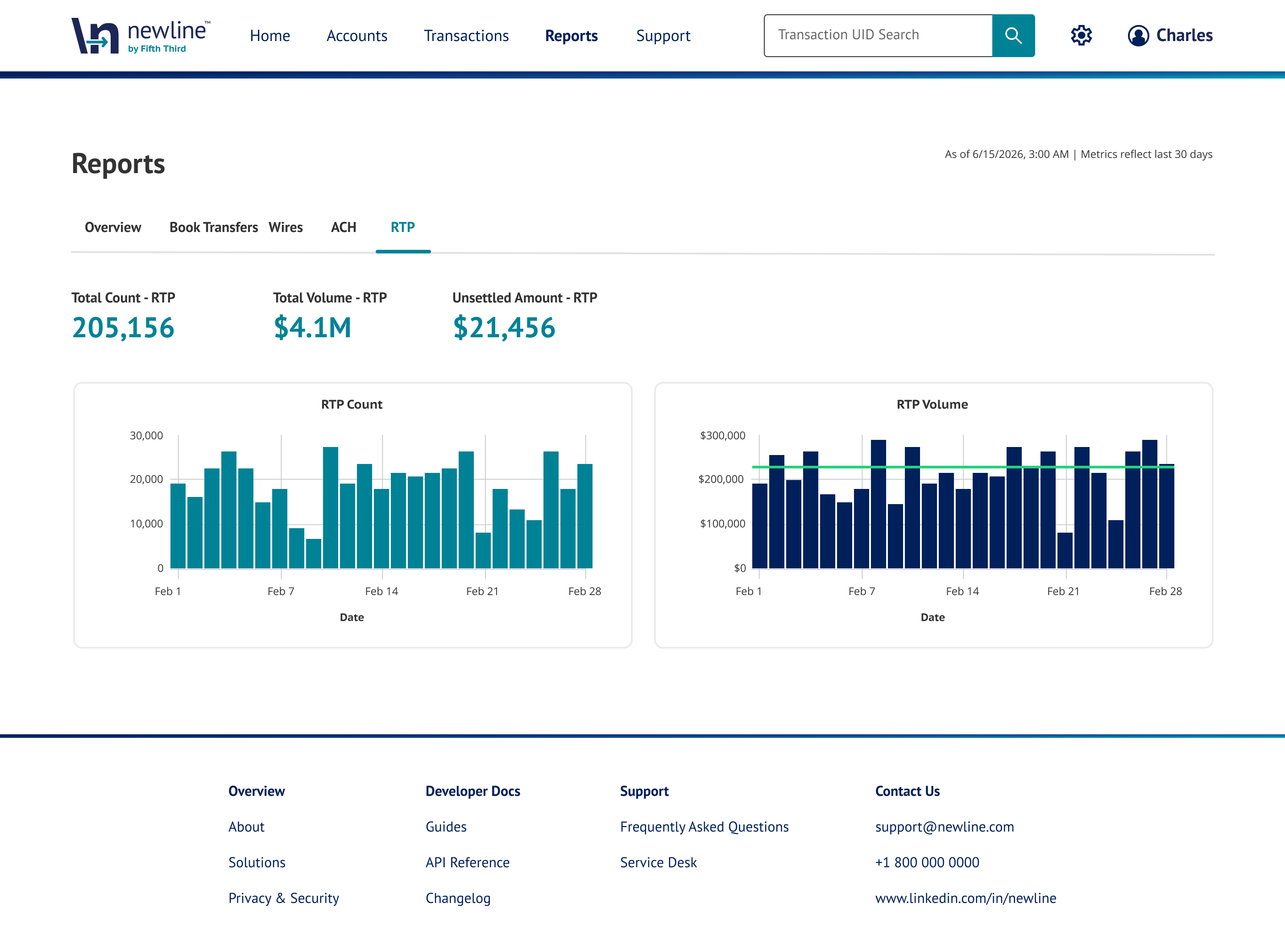
Summary Metrics
- Total Count – RTP – Total number of RTP transactions
- Total Volume – RTP – Total value of RTP transactions
- Unsettled Amount – RTP – Total value of RTP transactions that have not yet settled
Visualizations
- ACH Volume – Displays RTP transaction volume over time
- ACH Count – Displays RTP transaction count alongside return rate trends
Key Insights
Reports help users:
- Monitor transaction trends over time
- Compare performance across payment rails
- Identify returned or unsettled transactions
- Analyze activity volumes for operational and financial review
Support Tab
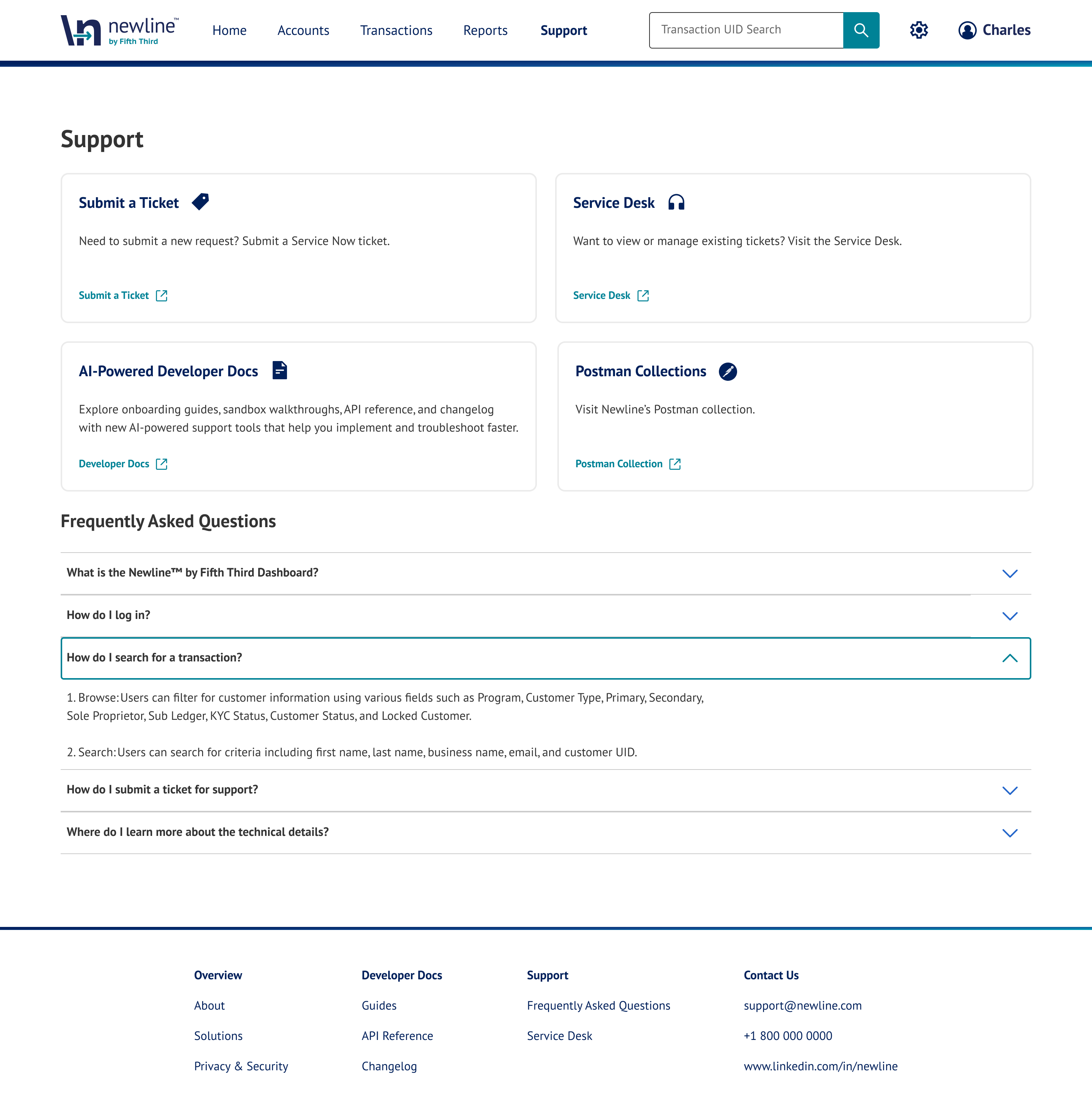
Provides quick access to assistance and documentation resources directly from the Home screen:
- Service Desk for submitting and managing support requests
- Frequently Asked Questions (FAQs) for common inquiries
- Developer Documentation for technical guidance, onboarding resources, and API references
Team Management
Users click on the profile picture in the upper right corner to navigate to Team Management
On the My Profile tab, users can view their profile and role in the system
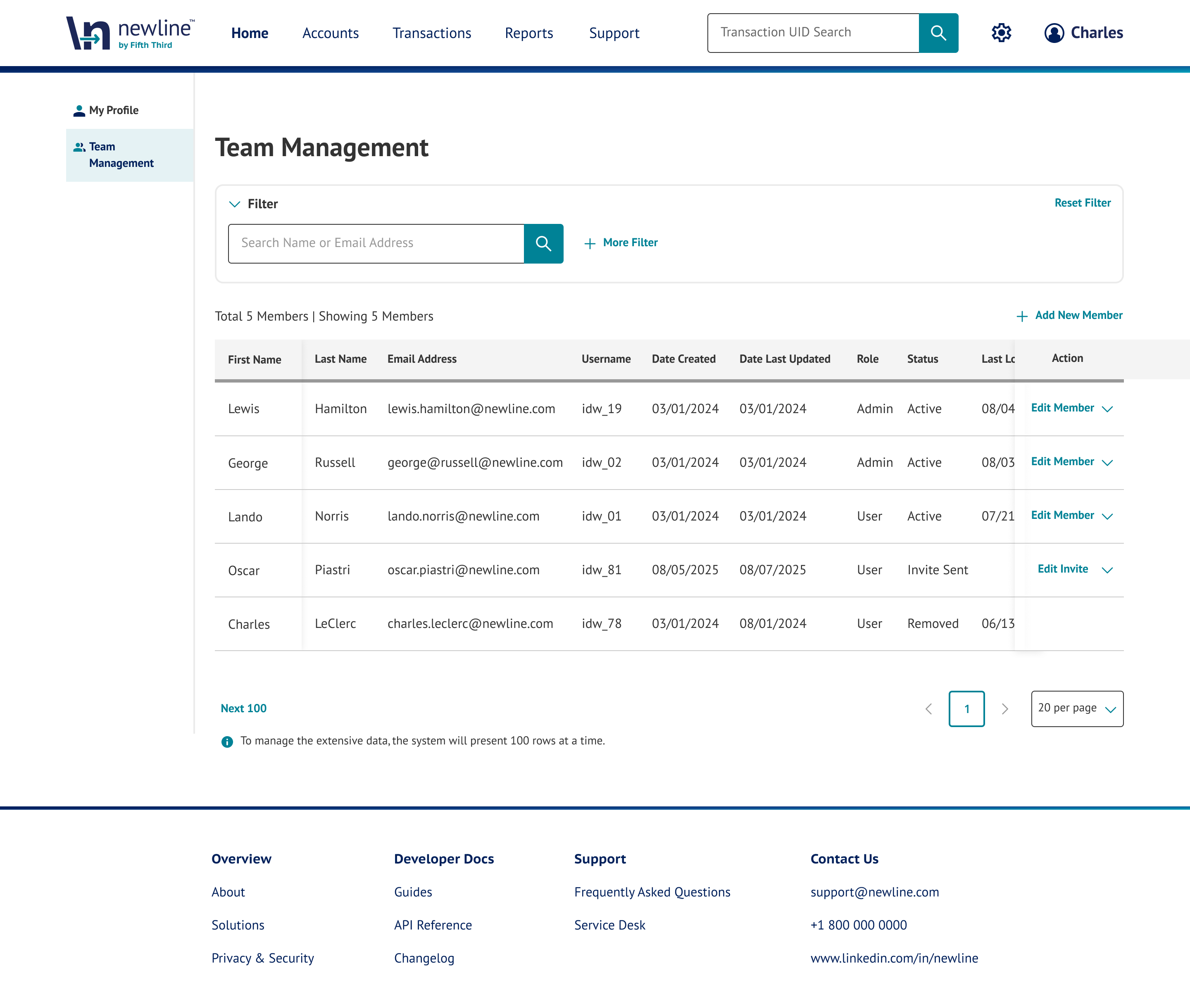
Click your profile icon in the upper-right corner to access Team Management.
User Roles and Permissions
| Role | Capabilities |
|---|---|
| Admin | Invite and remove users, manage access, reset MFA |
| User | View dashboard data and transaction activity for assigned program |
Date Range Filtering
Adjust the data displayed across the Home screen by selecting predefined time ranges of 7, 14, or 30 days, allowing you to analyze recent performance and trends.
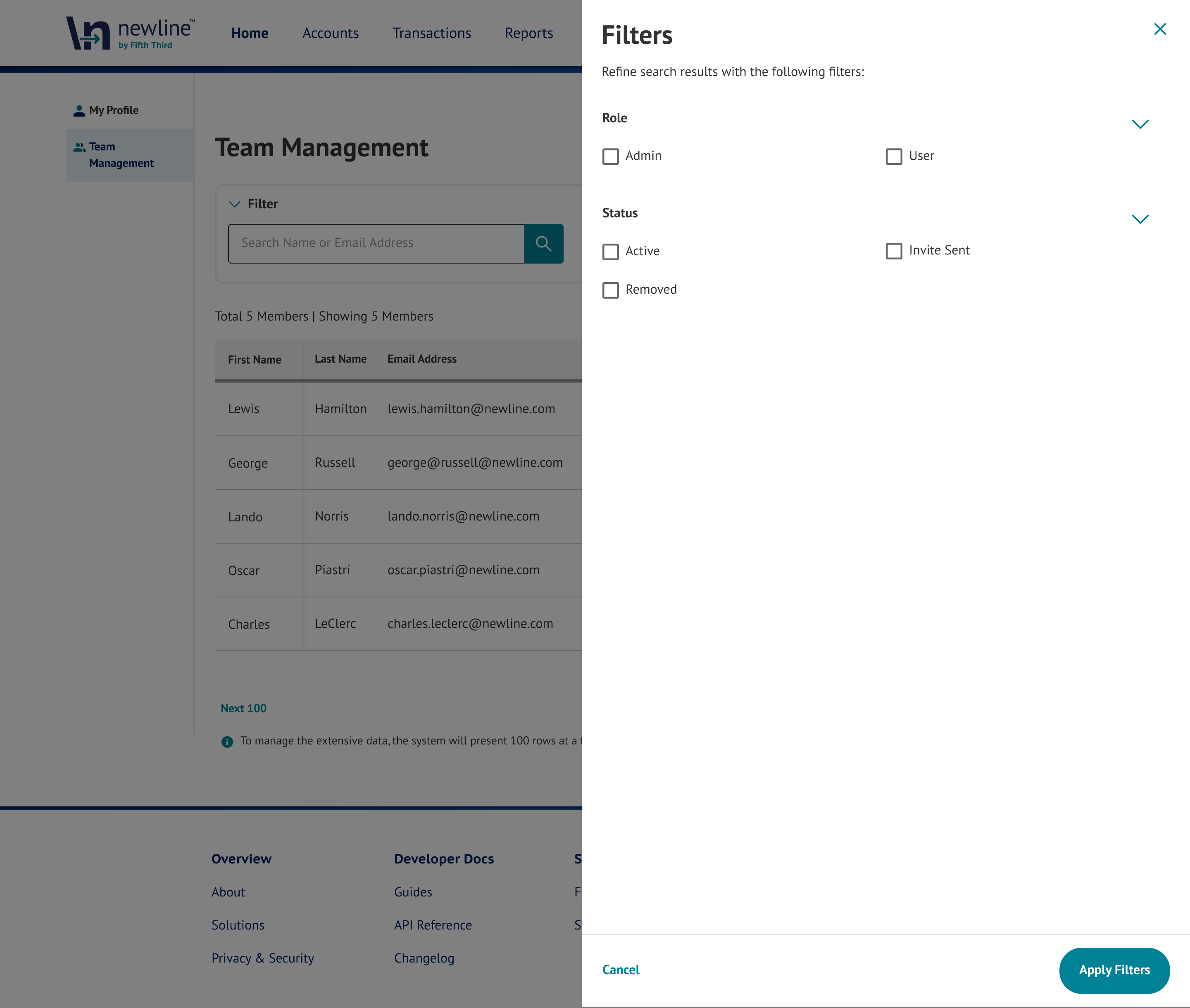
Support Page
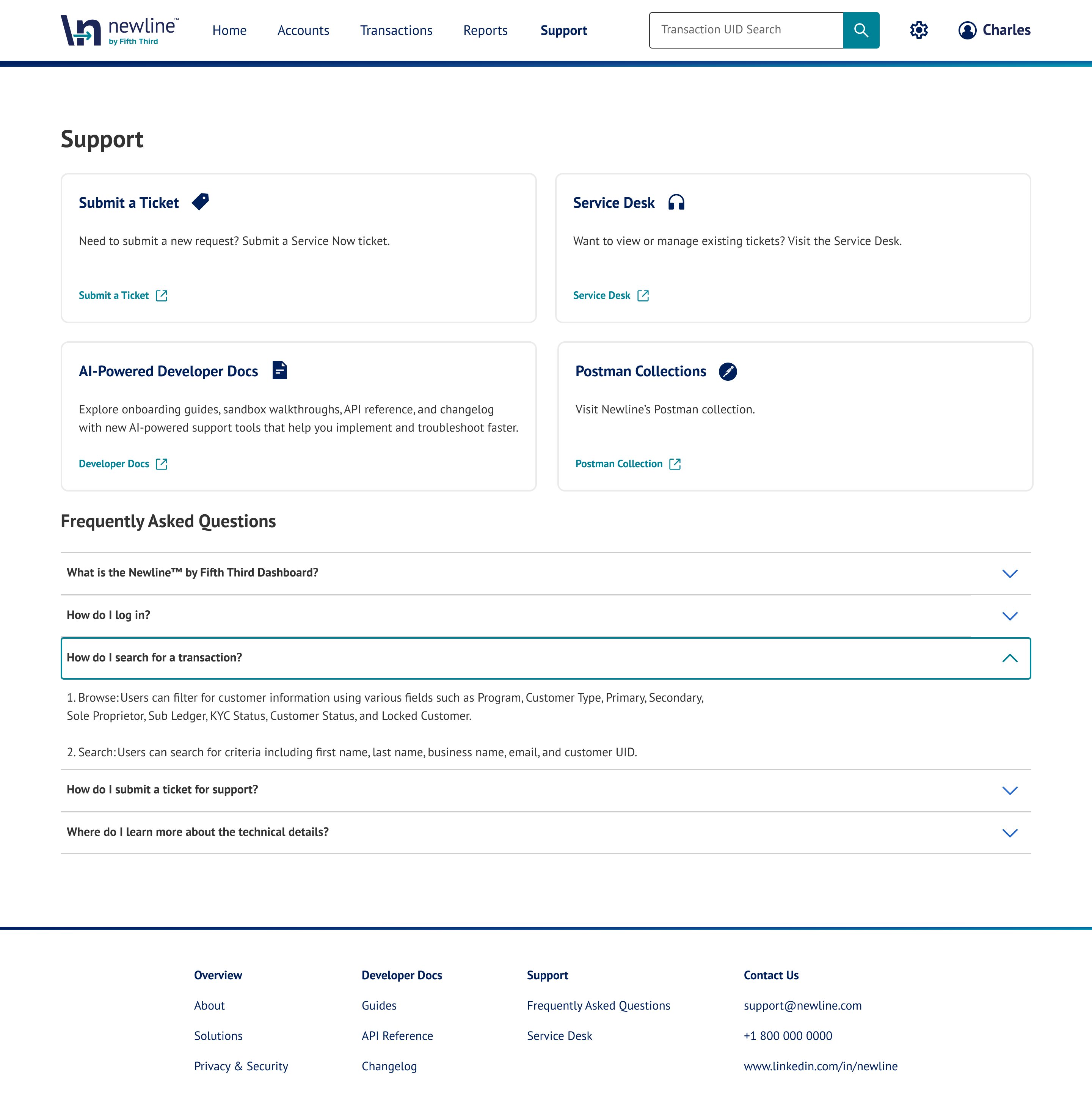
The Support page, as shown above, provides quick access to essential resources for troubleshooting and assistance. Users can navigate to this page from the Home screen or by selecting Support in the navigation header.
Use the Support page when you need assistance with account access, transaction investigations, or unexpected behavior in the platform. For general usage questions, refer to FAQs or Developer Documentation before submitting a ticket.
The page includes direct links to:
- Submit a Ticket – Create a new Service Desk support request.
- Service Desk – View or manage existing tickets.
- Developer Docs – Access onboarding guides, API references, and changelogs.
- Postman Collections- Access Newline's Postman collection.
Additionally, the Frequently Asked Questions (FAQs) section offers answers to common inquiries, such as login steps and transaction search guidance.
Additional Resources
For quick answers and troubleshooting help, explore these key areas in our Developer Docs:
-
FAQs Covers common questions about using the Dashboard, APIs, authentication, and support processes.
-
API Error Codes & Troubleshooting A reference guide to common error messages, what they mean, and how to resolve them—especially helpful when working with transaction or webhook APIs.
-
Other Useful Developer Documentation:
- API Guides Step-by-step instructions for getting started with Newline APIs and integrating with the Dashboard.
- Recipes Practical examples and use cases to help you implement common workflows faster.
- API Reference Detailed specs for all available endpoints, parameters, and response formats.
- Changelog Stay up to date with the latest product and documentation updates, including new features and fixes.
Updated 4 months ago